



Colin Ripsman and Bob Fitzpatrick
Real estate continues to offer long-term diversification and income potential for pension plans, but current market conditions call for a more selective approach. The authors examine the key risk management strategies that trustees should consider to enhance investors’ success in a stressful real estate market.

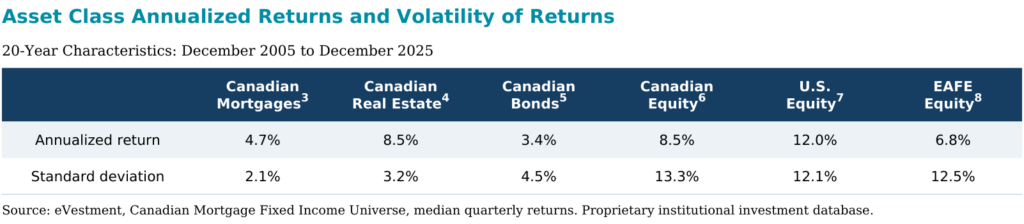
The evolution of pension portfolios over the past two decades has been marked by a steady shift toward alternative investments, with real estate playing an increasingly prominent role. Since 2000, Canadian defined benefit pension plans have increased their allocation to alternative asset classes to just over 20% of total assets, with real estate representing a significant share of that growth.1 Over that same period, the average allocation among pension funds to real estate (equity and debt) has almost doubled, rising from approximately 3% to 7%.2
Real estate has become an attractive asset class for institutional investors because it offers the potential for stable income, competitive long-term returns and relatively low volatility. The major trade-off associated with real estate is lower liquidity: Direct real estate holdings are less liquid than publicly traded equities and bonds, and many private real estate funds impose redemption restrictions. However, most pension plans are well-positioned to bear this illiquidity. Their long-term obligations and investment horizons allow them to allocate a meaningful portion of their portfolios to less liquid assets in exchange for improved diversification and enhanced risk-adjusted returns.
The Current Environment for Real Estate
Since COVID, we have experienced dislocations in some key segments of the real estate market:
- The office sector has been impacted by work-from-home trends, which have reduced demand for office leases and correspondingly placed downward pressure on rental renewal rates. Canadian office vacancy rates are currently sitting at around 19%, an 8% rise from pre-COVID-19 levels in 2019.
- Retail, particularly large fashion malls, have been impacted by online shopping trends that strengthened during COVID-19 (e-commerce’s share of retail sales doubled from 3.5% in 2019 to 7% in 2025) and continue to pressure vacancy rates and rental renewal rates.
- The condominium market has been negatively impacted by oversupply in the many major markets across Canada.
Historically, Canadian core real estate portfolios have generated returns in the 8% to 9% range annually. Approximately 5% of that return was attributed to income, with the remaining balance attributable to capital gains.9
In a stressed market, we can expect some rental compression. More importantly, a stressed market may severely constrain the portfolio’s capital gains. Depending on the portfolio’s holdings, an investor may be facing minimal capital gains or even capital losses.
From December 2019 to December 2025, core Canadian real estate equity delivered an annualized return of roughly 5.1%, largely stripped of its capital appreciation component. In contrast, mortgage funds delivered 4.0%.10 On a risk-adjusted basis, debt outperformed equity significantly during this window.
An additional impact of this stressed real estate market may be reduced liquidity. Real estate funds may be structured as open-ended funds that permit periodic liquidity (often quarterly) or closed-ended funds that do not permit liquidity until the fund is liquidated at the end of the investment period. In the case of open-ended funds, a depressed real estate market may limit the ability to sell properties to fund withdrawals. At the same time, a fund manager may not want to force the liquidation of key properties at depressed prices to fund withdrawals. This may lead some open-ended fund managers to gate their funds to restrict redemptions.
Takeaways
- Real estate can still play a valuable role in pension portfolios, but weaker market conditions have reduced the capital appreciation that historically supported core real estate returns.
- Commercial mortgage allocations may offer a more attractive risk-return trade-off than real estate equity in stressed markets because returns are driven primarily by interest income and collateral protection rather than property value appreciation.
- Floating rate mortgages can help investors manage interest rate volatility by providing higher current yields, interest rate floors and lower sensitivity to rate changes than fixed rate mortgage portfolios.
- Strong underwriting and portfolio construction are critical; investors should focus on loan-to-value ratios, debt service coverage, recourse provisions, diversification, exposure to land and construction, and valuation confidence.
- For long-term investors such as pension plans, the opportunity is not simply to increase real estate exposure, but to be selective about where risk is taken and how liquidity, credit quality and downside protection are managed.
The Case for Mortgage Allocations
Over the long term, Canadian real estate remains an attractive asset class. However, in stressed markets, real estate debt can be more attractive than real estate equity. Real estate debt portfolios are collections of mortgages with the underlying real estate holdings as collateral. Like real estate equity holdings, commercial real estate mortgages are generally not liquid. However, given their finite terms (usually ranging from one to ten years), liquidity can be managed more effectively.
Mortgage returns are primarily driven by interest payments generated from the underlying mortgages. Capital gains and losses can result from interest rate fluctuations; however, the mortgages will ultimately pay off at par value.
Mortgages do not participate in any equity appreciation in the underlying property. In strong markets, this may be a limitation, as capital appreciation can be material. However, in stressed markets, mortgages are shielded from capital losses on the underlying properties.
Commercial mortgages are structured like bonds, although their interest rates are higher than those of traditional bonds to compensate investors for lower liquidity. The benefits of commercial mortgages relative to traditional bonds include the following:
- Higher yields – Commercial mortgage funds offer attractive yield spreads over traditional bond portfolios. Investors are effectively trading off some liquidity for a significant yield enhancement. In the current environment, the yield enhancement over Canadian bonds is about 1%.11
- Safety – Commercial mortgages, backed by high-quality commercial properties, offer enhanced yields with little exposure to real estate price fluctuations. Core mortgage portfolios have low loan-to-value ratios (typically below 65%), which protects them, even in the face of a market downturn. Unlike direct investments in real estate, mortgage income is received without direct ownership of the underlying real estate, thereby reducing exposure to real estate market volatility.
- Less interest rate sensitivity – The duration of commercial mortgage portfolios tends to be lower than most traditional bond portfolios, better protecting mortgage portfolios in the event that interest rates rise.
- Strong risk/return characteristics – Commercial mortgage portfolios have had low correlations with public equities. They also have lower volatility than many other yield enhancement strategies, such as corporate bonds. Accordingly, an allocation to mortgages in a traditional balanced portfolio can reduce overall portfolio volatility.
Floating Rate Bonds Versus Fixed Rate Mortgages
Most commercial mortgage portfolios are comprised primarily of fixed rate mortgages. Fixed rate mortgages structure loans over a fixed term, often five to ten years, with a fixed interest rate payable over the mortgage term. These portfolios behave like traditional bond portfolios: When interest rates fall, their value increases. Conversely, when interest rates rise, the portfolio experiences a capital loss. Portfolio returns comprise the interest paid on the loan plus any capital gains or losses. In volatile markets, where interest rates fluctuate, the capital component can introduce significant volatility in portfolio returns.
Floating rate mortgages are loans in which the interest payment obligations fluctuate with the prevailing market interest rate. Normally, the obligation is tied to the current bank prime rate. A typical core loan may require the borrower to pay a rate equal to the bank’s prime rate plus 1.5% to 2%. The interest rate obligation rises and falls with changes to the bank prime rate. There are some significant benefits to floating rate mortgages:
- Higher interest rates – Variable rate mortgages command higher interest rates. Fixed rate mortgages are priced with a spread above Government of Canada bond yields, while variable rate mortgages are priced with a similar spread above bank prime rates (a higher base rate). By moving from fixed rate to variable rate mortgages, investors can increase their yields by 1.5% to 2% per loan.
- Interest rate floors – Variable rate mortgages are normally negotiated with a floor on interest payments. This creates a more favourable, asymmetric, interest rate trade-off. When interest rates rise, floating rate mortgage payment obligations rise in lockstep with the rates. However, when rates fall, the interest rate payments cannot fall below the negotiated floor.
- Lower volatility – Because the duration (interest rate sensitivity) of a floating rate mortgage is near zero, the value of floating rate mortgages is not impacted by interest rate shifts. As a result, the volatility of variable rate portfolio performance tends to be lower than that of fixed rate funds.
- Lower correlation with traditional fixed rate portfolios – The extremely low duration of floating rate mortgage portfolios, together with the interest rate floors, results in low correlations with traditional fixed income portfolios.
How to Better Manage Real Estate Risk
When investing in mortgages in a volatile market, investors may use the following framework to assess and control portfolio risk.
1. Portfolio risk measures – There are some key measures that can telegraph the risks assumed by the portfolio:
- Loan to Value (LTV): This represents the ratio between the total loans extended in the portfolio, divided by the current market value of the collateral in the portfolio. This measure identifies the equity cushion held in the portfolio. A typical core portfolio will have an LTV below 65%. In the event of a default on a mortgage loan, the property will be used to satisfy the outstanding mortgage obligations. As long as there was not a market correction of more than 35%, the property should be able to fully satisfy the outstanding obligation. The lower the LTV, the higher the equity cushion protecting the loans.
- Debt service coverage ratio (DSCR): This represents the ratio between the cash flows generated by the portfolio through rents, divided by the debt servicing obligations payable on the mortgages. A core portfolio will normally have a DSCR above 1.1x. This means that the income generated by the portfolio exceeds the ongoing debt obligations by at least 110%. The higher the DSCR, the higher the portfolio quality and the greater the margin of protection for lenders.
2. Recourse – “Nonrecourse” debt is common in the U.S., but Canadian markets frequently utilize “Recourse” or “Personal Guarantees.” This allows the lender to pursue the borrower’s other assets if the property value falls short. Portfolios with high recourse percentages represent significantly lower credit risk.
3. Credit analysis – A key element to the quality of any mortgage portfolio is the quality and rigor of the credit analysis performed by the underwriting team. One way to assess the strength of the credit rating team is to evaluate the thoroughness of the ratings process and the underwriting team’s experience and tenure. An important measure of success for the underwriting team is the portfolio’s historical default history and the team supporting it.
4. Portfolio diversification – An important way to reduce risk in a mortgage portfolio is to ensure broad diversification in the portfolios across sectors, geographical regions and individual borrowers.
5. Land and construction – A high allocation to undeveloped land or construction projects will increase the risk in a mortgage portfolio. These properties do not generate income and may be subject to regulatory approvals or construction delays. Future cash flows from these projects may also be negatively impacted by economic downturns or shifts in regional demand trends.
6. Valuation confidence level – A real estate equity portfolio or mortgage portfolio may be negatively impacted by changes in property valuations. This is a particular concern in stressed markets. Generally, the longer the fund has held the property or mortgages in its portfolio, the more at risk it may be of stale valuations. To the extent that a portfolio holds shorter-term loans with properties that have transacted in the open market more recently, this risk can be better managed.
Conclusion
Real estate remains an attractive asset class for pension funds, even in a challenging market environment. However, investors can improve portfolio resilience and risk-adjusted returns by emphasizing the following strategies.
1. Increase exposure to mortgage investments, which may offer a more attractive risk-return profile than equity real estate in weaker market conditions.
2. Favour floating rate mortgage portfolios, which can provide higher yields while reducing interest rate risk relative to fixed rate portfolios.
3. Prioritize disciplined portfolio risk management, including prudent underwriting standards, historically low default rates, limited exposure to land and construction lending, and a focus on current property valuations.


Endnotes
1. Statistics Canada. “Table 11-10-0084-01 Trusteed pension funds, value of assets by sector, quarterly (x 1,000,000)” and “Table 11-10-0076-01 Trusteed pension funds, value of assets by sector, quarterly, inactive (x 1,000,000).”
2. Ibid.
3. Based on the eVestment Canadian Mortgage Fixed Income universe median quarterly returns.
4. Based on the eVestment Canadian Private Real Estate universe median quarterly returns.
5. Based on the BlackRock Canada Universe Bond Index fund returns.
6. Based on the BlackRock Canadian Equity Index fund returns.
7. Based on the BlackRock US Equity Index fund returns.
8. Based on the BlackRock EAFE Index fund returns.
9. Based on the eVestment Canadian Private Real Estate universe median quarterly returns for the 20- and 25-year periods ended December 31, 2025.
10. The eVestment Canadian Private Real Estate universe median 6-year return for the period ended December 31, 2025.
11. EIS calculations based on the constituent yields of the eVestment Canadian Mortgage Fixed Income universe and the Canadian Core Fixed Income universe as of March 31, 2026.